Forex Trading Basics Every Beginner Needs
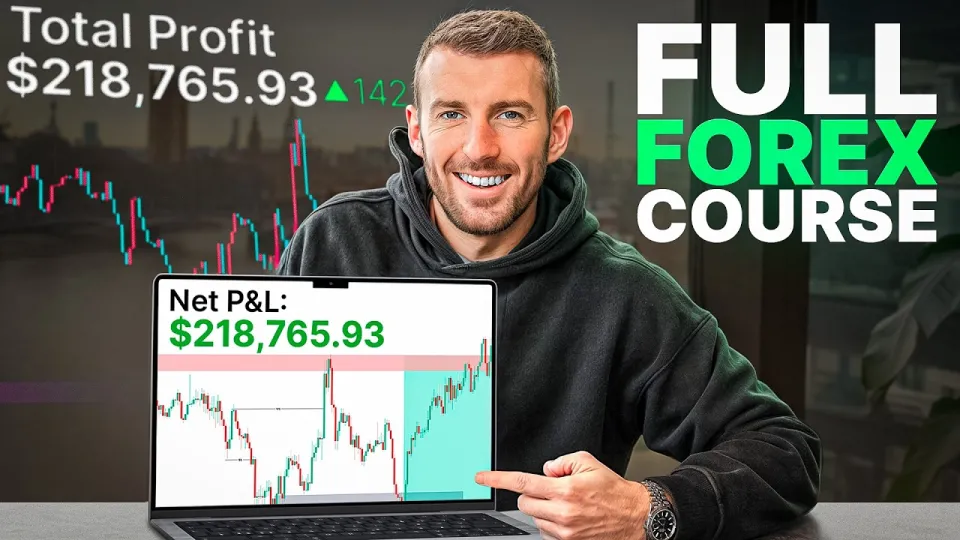
Video: Beginners Guide To Forex Trading In 2026 (+3 hours)
Need articles like this for your video? They help promote it on YouTube and Google — order them in the Telegram bot @sat_sit_bot. Articles with your video embedded are written and posted by the bot itself — on popular topical sites (no ads). Your first 50 articles are free.
· based on the channel Matt Donlevey - Photon Trading
Forex is the global market where national currencies are bought and sold against each other in pairs, and it is the largest and most liquid financial market in the world, trading around the clock on weekdays. For a beginner, the practical starting point is understanding what actually moves price — orderflow, liquidity, and the auction between buyers and sellers — before touching a chart pattern. Matt Donlevey's Photon Trading course, published as a full beginner's guide, builds exactly that foundation and pairs it with a free course and cheatsheets you can grab at the Photon Trading free training page.
What forex trading actually is
Forex trading means speculating on the exchange rate between two currencies, such as EUR/USD, where the euro is the base currency and the US dollar is the quote currency. Unlike stocks, there is no central exchange: currencies trade over the counter through a network of banks, brokers, and liquidity providers, which is why the market runs 24 hours a day, five days a week, across the Sydney, Tokyo, London, and New York sessions.
A few structural facts shape everything else:
- Currencies are always quoted in pairs, and the price you see is how much of the quote currency one unit of the base currency costs.
- Most retail volume concentrates in a handful of majors: EUR/USD, GBP/USD, USD/JPY, USD/CHF, AUD/USD, and USD/CAD.
- Leverage lets you control a large position with a small deposit, which magnifies both gains and losses — the reason risk control comes before strategy.
- The London–New York overlap is typically the most liquid window of the day, and liquidity determines how easily your order fills at the price you want.
Why technical analysis alone fails
Technical analysis gets a bad reputation because geometric shapes on a chart do not explain why price moves; they only describe what already happened. A triangle, a head and shoulders, or a trendline tells you nothing about who is buying, who is selling, and where resting orders sit. The alternative is to study the underlying mechanics: how orders are matched, where liquidity pools, and how price is auctioned between participants.
That shift in perspective is the core argument of the course. Instead of memorizing patterns, you learn to read the market as a continuous auction, then build a strategy on that logic. It is slower to learn, but it produces rules you can test and repeat rather than setups you have to believe in.
Market microstructure and orderflow in plain terms
Market microstructure is the study of how trades are actually executed, and it starts with three numbers: the bid, the ask, and the spread. The bid is the highest price a buyer will pay, the ask is the lowest price a seller will accept, and the spread is the gap between them. Every market order pays the spread on entry, so it is a real cost, not a rounding error — on tight majors it may be a fraction of a pip, while on exotic pairs or during news it can widen sharply.
The orderbook is the running list of pending bids and asks at each price level. Large clusters of resting orders act like magnets and barriers: price often moves toward them because that is where liquidity is available, and accelerates through them once they are consumed. Auction market theory frames this as a search for fair value — price moves up and down until buyers and sellers agree on a level, then ranges until new information forces a repricing.
Orderflow is the record of aggressive buying and selling hitting the market. When you see price push through a level and hold, real orders absorbed the opposing liquidity; when it spikes and snaps back, the move lacked follow-through. Reading orderflow means asking who is trapped, who is filled, and where the next pool of orders sits.
Building a trading strategy step by step
A strategy is a written set of conditions that tells you when to enter, where to place a stop, how much to risk, and when to exit. The course walks through a structured build:
- Define market structure — identify whether the market is trending up, trending down, or ranging, using swing highs and swing lows.
- Mark premium and discount — split the current range in half and favor buying in the lower half and selling in the upper half, so you are not chasing.
- Check multiple timeframes — align the higher-timeframe direction with the lower-timeframe entry so you are not trading against the dominant flow.
- Map supply and demand — find the zones where price previously reversed with force, because unfilled orders often remain there.
- Identify liquidity — locate the highs, lows, and equal levels where stops cluster, since price frequently reaches for them before reversing.
- Define entries, management, and risk — a fixed percentage risk per trade, a predefined stop, and rules for partial exits and breakeven.
Each of those steps is a filter. The more of them a setup satisfies, the fewer trades you take and the higher the quality of each one.
Money management, psychology, and common mistakes
Money management is the part that keeps you in the game: risk a small, fixed percentage of the account per trade, size positions from the stop distance rather than from a round lot, and never let one loss exceed your plan. Three mistakes come up again and again for beginners — risking too much on a single idea, jumping between strategies before any of them has been tested, and trading without a written plan.
Trading psychology usually gets blamed too early. The more useful sequence is to build an edge first, prove it in backtesting, and only then work on discipline, because emotional control is much easier when you trust the rules you are following. A trade journal closes the loop: record the setup, the reason for entry, the outcome, and the emotion behind the decision, then review the entries weekly for patterns.
Choosing a broker and executing your first trade
Broker selection comes down to regulation, execution quality, spreads and commissions, and platform reliability. Check which regulator supervises the broker, compare all-in trading costs rather than advertised spreads alone, and confirm the platform supports the order types your plan requires. Before risking real money, run the strategy on a demo account, then execute live with the smallest size your broker allows until the process feels routine.
Common questions from new traders
Many viewers of the course ask whether a three-hour guide is really enough to start, and the honest answer is that it is enough to build a framework, not to become profitable — that takes screen time and a tested plan. Others worry about the pace and accent; slowing playback and rewatching the microstructure sections helps, and the written cheatsheets cover the same ground. A frequent doubt is whether free material can be serious: the structural concepts here are the same ones sold in paid mentorship programs. And the recurring question about account size is best answered by risk math — with 1% risk per trade, a small account simply trades smaller, which is why process matters more than starting capital.
Useful links
- Free Photon Trading course and cheatsheets: https://www.photontradingfx.com/free-training?el=beginnersguide&htrafficsource=YT
- Photon Mentorship program: https://www.photontradingfx.com?el=beginnersguide&htrafficsource=yt
- Free Telegram channel with analysis and trade recaps: https://t.me/photontrading
- Instagram: https://www.instagram.com/photontrading/
Final thoughts
Forex rewards traders who understand mechanics before setups: the spread you pay, the liquidity you trade into, and the structure that frames every entry. Build a written plan, test it on historical data, size positions by risk rather than conviction, and journal every trade so the feedback loop stays honest. The full breakdown behind these ideas comes from the Matt Donlevey - Photon Trading channel, whose beginner's guide covers microstructure, market structure, and money management in one place. If you want the structured version, start with the free course at Photon Trading's free training page and work through it with a chart open.
Key takeaways
- Forex is an over-the-counter market where currencies are quoted in pairs, and the spread between bid and ask is the first cost every trade pays.
- Matt Donlevey's Photon Trading guide runs over three hours and covers market microstructure, orderflow, market structure, supply and demand, and liquidity concepts.
- Price movement is explained through auction market theory and orderflow rather than geometric chart patterns, which the course argues explain nothing on their own.
- A complete beginner workflow includes a written trade plan, backtesting, broker selection, trade journaling, and money management rules.
- The free Photon Trading course and cheatsheets are available through the photontradingfx.com free-training page.
Questions & answers
Do I need a large account to start trading forex?
No. Position size is calculated from the distance to your stop and the percentage of the account you are willing to risk, so a small account simply trades smaller lots. With 1% risk per trade, a $500 account risks $5 per trade, which is enough to practice execution and journaling without exposing much capital.
Is technical analysis useless in forex?
Patterns on their own describe price but do not explain it, which is why they fail so often in isolation. Used together with market structure, liquidity levels, and orderflow, chart reading becomes a tool for locating where orders sit rather than a prediction method.
How long does it take to become consistently profitable?
There is no fixed timeline, but the sequence matters more than the duration: learn the mechanics, write a plan, backtest it across many trades, then trade small live. Most traders who skip backtesting and journaling restart the learning curve repeatedly instead of building on results.
What costs should a beginner compare between brokers?
Look at the spread on the pairs you actually trade, any commission per lot, swap charges for positions held overnight, and slippage during volatile sessions. Regulation and execution reliability matter as much as headline pricing, since a tight spread is worthless if fills are poor.
Source: Beginners Guide To Forex Trading In 2026 (+3 hours) · Markdown version